

Short answer
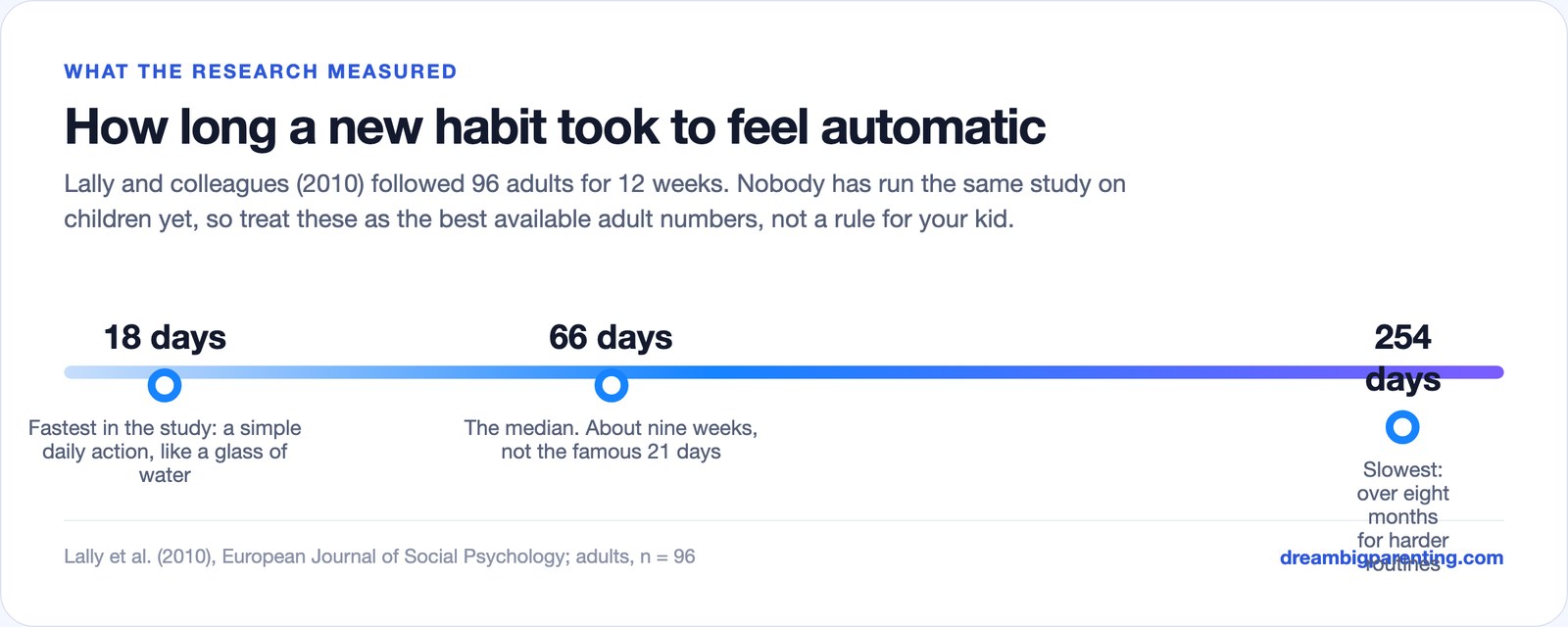
How long does it take a child to form a habit? No timing study has included children. The famous 21 days is a myth from a 1960 plastic-surgery book. The best adult data, from 96 volunteers, puts the median at 66 days, range 18 to 254. Plan on months, keep the cue the same every day, and mark each repeat visibly.
Say your 10-year-old agreed to practice guitar daily. By week three you are the one reminding, and the thought arrives: it has been 21 days, so where is the habit? The disappointment is built into the number.
How long does it take a child to form a habit? Where the numbers come from
Three numbers do the rounds: 21 days, 66 days, and "by age 9." Only one comes from timing a habit.
What the research says
- 21 days is not a study. Plastic surgeon Maxwell Maltz wrote in Psycho-Cybernetics (1960) that patients took "a minimum of about 21 days" to adjust to a new face (via James Clear). Not a study of repeated behavior, and not children.
- 66 days is the median, in adults. Lally, van Jaarsveld, Potts and Wardle (2010) followed 96 adults for 12 weeks, one daily behavior each, tied to an existing cue. "The median time to reach 95% automaticity was 66 days (range: 18 to 254 days)," as a 2024 review quotes it; 254 is a modeled upper value.
- 21 days is refuted, and no child has been timed. That review by Singh, Murphy, Maher and Smith (2024) pooled 20 studies and 2,601 adults: medians of 59 to 66 days, individuals from 4 to 335. Its results "clearly refute the popular notion that habits can be formed in approximately 21 days." It included only "adults over the age of 18."
- "By age 9" answers a different question. A survey of nearly 50,000 U.S. families (via Psychology Today) found chore routines assigned by about third grade held through high school. Persistence over years, not days to automaticity.
Our read
The honest answer for a child is "we do not know, and probably not 21 days." Adults with a self-chosen habit needed a median of two months; a kid with a parent-suggested one is unlikely to be faster. We plan around 66 days, not 21. Our interpretation, not a finding.
What speeds a habit up for a child
The same adult research points at three levers, none tested on children, so treat them as good guesses.
Same cue, every day. Every habit in Lally's study was tied to something that already happens daily. "After breakfast" is a cue; "sometime in the afternoon" is a wish. The 2024 review also found morning habits stronger than evening ones, shown for one behavior, stretching.
An if-then plan. Across 94 tests, an implementation intention ("If [cue], then I will [behavior]") produced a medium-to-large gain in follow-through, d = 0.65, over intention alone (Gollwitzer and Sheeran, 2006). Adults again, but it costs nothing: "If I finish dinner, then my plate goes in the dishwasher."
A visible mark. Practical advice, not a finding. A checkbox on the fridge or a chain of ticks makes an invisible streak visible, so a slow start reads as progress. Our piece on reward charts versus progress charts explains why it works best tracking a goal the child picked. The DreamBig app, coming soon to iPhone and Android, runs on that idea: a dream's price splits into squares, and every saving reveals a piece of the picture.
And one lever above them: in the review, self-chosen habits beat assigned ones. Let your child pick.
| Age | Cue | If-then sentence | Visible mark |
|---|---|---|---|
| 8–10 | Parent proposes, child agrees | "After I brush my teeth, my backpack goes by the door" | Fridge chart; the child marks it |
| 11–13 | Child picks from a shortlist | Child writes it; parent reads it once | Child keeps it; weekly check-in, not daily |
| 14–17 | Child owns habit and cue | Written or not, their call | Their choice; parent says months, not weeks |
What does not work, and why
Waiting for day 21, then quitting. The adult median is roughly three times that. A habit that still needs a reminder at week three is on schedule. If your child wants out anyway, see whether to let a child quit.
Assigning habit and schedule with zero input. In adults, assigned habits formed more weakly. Extrapolate cautiously, but it fits what we know about motivation without pressure.
A 7-day experiment
Seven days will not build a habit, but it will test whether the cue fits your child's day.
Try this at home · 7 days
- Offer it once. Your child picks one small action and a cue that already happens daily. If they say no, drop it.
- Write the if-then sentence together, in their words, and post it where the cue happens.
- Add a seven-box strip. Your child makes the mark, nobody else.
- On day 7, count the marks and ask: did the cue come at the right moment? Adjust the cue, not the child.
If the strip keeps going, fold it into your weekly family goal review and our hub on goal setting for kids.
Key takeaways
- The 21-day rule comes from a 1960 book about adjusting to a new face, not a study.
- The best data, from 96 adults, puts the median at 66 days, range 18 to 254.
- No study has timed habit formation in children; adult numbers set expectations, not verdicts.
- What helped adults: a fixed daily cue, an if-then sentence, and choosing the habit themselves.
Frequently asked questions
Does it really take 21 days to build a habit?
No. It comes from Maxwell Maltz's 1960 observations of patients adjusting to a new face. The best timing studies found medians of 59 to 66 days.
How long does it take a child to form a habit, then?
No one has timed it in children. The main systematic review covered only adults over 18, with no children or teens in its 20 studies. Expect months, not weeks.
Isn't there a study saying habits take root by age 9?
A family survey found chore routines assigned by about third grade held through high school. Persistence over years, not days to automaticity.
What speeds up habit formation, according to research?
An if-then plan gave a medium-to-large boost to follow-through across 94 tests. In the 2024 review, morning and self-chosen habits came out stronger. All adult data.
Sources
- Singh, B., Murphy, A., Maher, C. & Smith, A. E. (2024). Time to Form a Habit: A Systematic Review and Meta-Analysis of Health Behaviour Habit Formation and Its Determinants. Healthcare (Basel), 12(23), 2488 (quotes Lally, van Jaarsveld, Potts & Wardle, 2010, European Journal of Social Psychology, 40(6), 998–1009).
- Clear, J. (n.d.). How Long Does it Actually Take to Form a New Habit? (Backed by Science). jamesclear.com (summarizes Maltz, 1960, Psycho-Cybernetics, and the Lally et al. sample).
- Gollwitzer, P. M. & Sheeran, P. (2006). Implementation intentions and goal achievement: a meta-analysis of effects and processes. Advances in Experimental Social Psychology, 38, 69–119.
- Jackson, R. (2015). Study Finds Habits in Children Take Root By Age 9. Psychology Today, School of Thought blog (on Pressman, Donaldson-Pressman & Jackson, The Learning Habit, 2014).

Ilya Makarov is the founder of DreamBig, a visual savings-goal app for kids and teens. DreamBig Parenting articles separate what research shows from our interpretation and from practical experiments, and link every source. This article is general information, not medical, psychological or financial advice for a specific child.