

Short answer
Is the 10000 hour rule true? Not as a law. The number is an average for the top group in a 1993 study of about 30 violin students; Gladwell's Outliers turned it into a rule. A 2014 meta-analysis of 88 studies found deliberate practice explains about 12% of performance differences overall, from 26% in games to under 1% in professions. Our read: hours matter, but the structure of practice, and the feedback in it, matter more.
The number is on posters at the music school and in the plans of a 13-year-old who has decided 10,000 hours of skateboarding is a career path. Here is where it came from, what the evidence says, and what to watch instead of the clock.
Where the 10,000 hours came from
In 1993, K. Anders Ericsson and colleagues studied violin students at Berlin's Music Academy. The best had trained for years, and by age 20 the top group averaged about 10,000 hours of practice (Ericsson and Pool). A small study: roughly 30 students, one conservatory, one instrument, adults recalling their own practice.
In 2008, Outliers made it famous. World-class expertise in any skill, Gladwell argued, is largely a matter of practicing the correct way for around 10,000 hours (Outliers).
Ericsson objected. The 10,000 was an average, not a finish line: "half of the ten violinists in that group hadn't actually accumulated ten thousand hours at that age." Reaching it made no one a finished expert. The popular rule, he wrote, "is wrong in several ways" (Ericsson and Pool, 2016).
What the numbers actually show
In 2014, Macnamara, Hambrick and Oswald pooled 88 studies on practice and performance.
What the research says
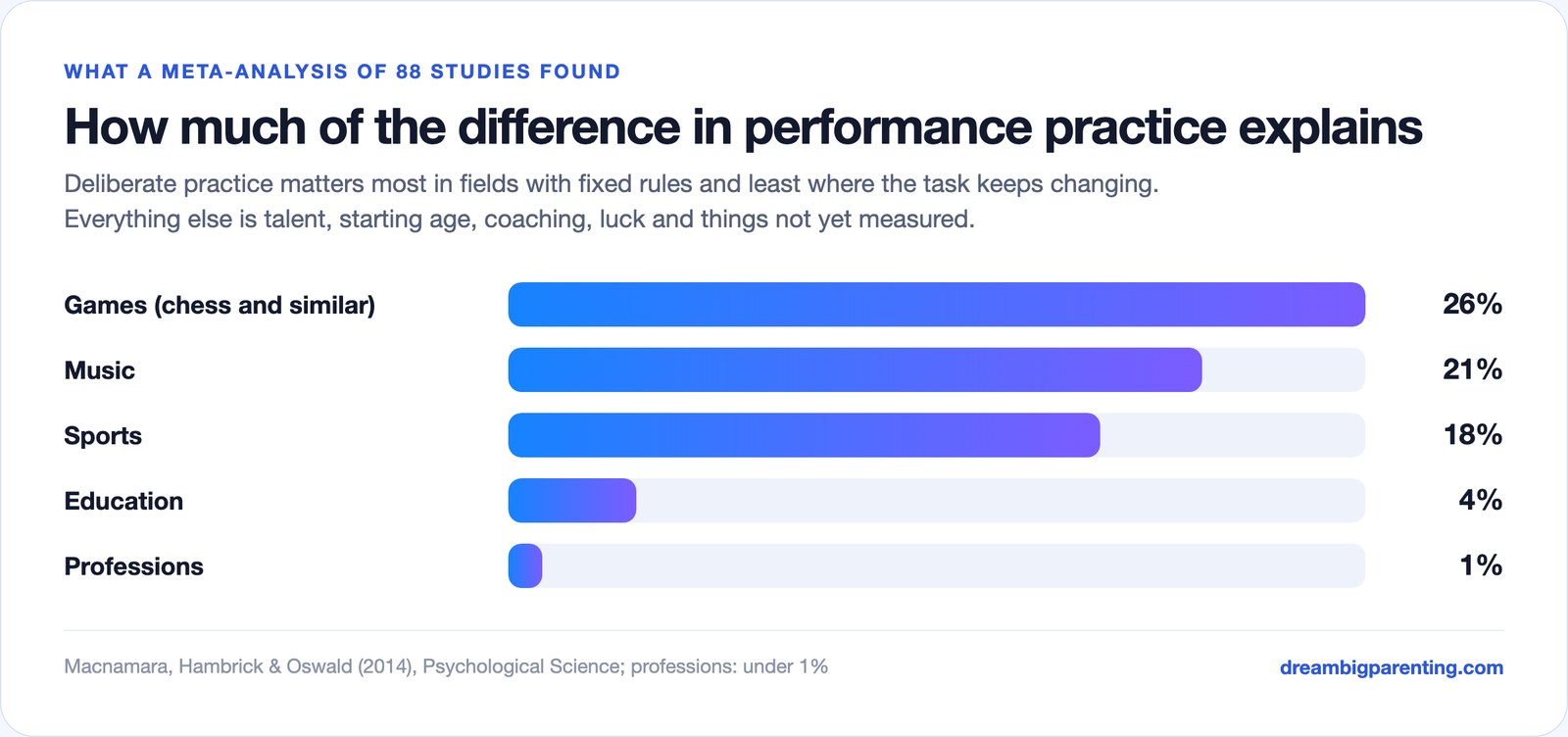
- Practice explains a different share in each field. Deliberate practice accounted for about 26% of performance differences in games such as chess, 21% in music, 18% in sports, 4% in education, and less than 1% in professions (Macnamara, Hambrick and Oswald, 2014).
- Overall, about 12%. Practice "accounted for only about 12% of individual differences," an average that hides the spread above.
- The rest is unmeasured. The authors named starting age and working memory as candidates, without quantifying either.
Limitations: correlational studies, pooled across varying definitions of "deliberate practice."
Our read
The pattern makes sense. Games have fixed rules and instant feedback, so practice can attack one weakness at a time. Careers keep changing the problem, and school sits closer to careers than to chess. 26% is still a lot for one factor. And the missing share is not simply talent: starting age, coaching, luck and things not yet measured.
Is the 10000 hour rule true for your child's practice?
Not as a target. But Ericsson measured a specific kind of time: "an hour of playing in front of a crowd," he wrote, "is not the same as an hour of focused, goal-driven practice." Deliberate practice aims at one weakness, with feedback, just past what the child can already do. Who holds each piece changes with age.
| Age | Session | Who picks the focus | Who gives feedback |
|---|---|---|---|
| 8–10 | 10–15 minutes | An adult names one thing to fix | The adult, inside the session |
| 11–13 | Still short; stop before focus drifts | The child names it first | Mostly the adult, teacher or coach |
| 14–17 | Teen and coach agree | The teen sets the goal | Coach or teacher; parent drives and cheers |
Practical suggestions, not findings from studies of children. The adult's share shrinks and the child's ownership grows, the same move as breaking a big goal into steps in our guide to goal setting for kids. A one-line practice log makes progress visible; the DreamBig app, coming soon to iPhone and Android, does the same for the guitar the child is saving toward.
What does not work, and a 7-day test
Counting hours. A chess app, an hour of scales, an afternoon at the rink: none of it is automatically deliberate practice. Vague coaching fails too; "nice job" is not the specific feedback the research describes. And "just put in the hours" for schoolwork is a weak bet: around 4%.
There is a quieter cost. A child told that mastery is 10,000 hours away can do the arithmetic and quit. Our pieces on letting a child quit, kids who give up easily and motivation without pressure share one premise: the next step has to look reachable.
Try this at home · 7 days
Your child can say no; the only comparison is with their own first try.
- Day 1: pick one weak spot. Not "practice guitar" but "the chord change in bar 8."
- Days 2–6: ten minutes on that spot, with feedback inside the session. A teacher, a recording, or you, naming what changed.
- Each day: log what changed, not minutes done. "Cleaner, still slow" beats "30 min."
- Day 7: compare with day 1. Ask what felt different. Then let them pick the next spot, or drop it.
Key takeaways
- The 10,000 figure was an average for the top ten violin students in one study; half of them had not reached it by 20.
- Outliers turned that average into a rule; Ericsson disputed it.
- Across 88 studies, deliberate practice explains about 12% of performance differences, from 26% in games to under 1% in professions.
- What matters is not the hour but one weak spot, feedback inside the session, and a level just past current skill.
Frequently asked questions
So is the 10000 hour rule true or not?
Not as popularly stated. Ericsson's violin study found an average of about 10,000 hours by age 20; half of the elite students had not reached it. Outliers turned that average into a rule, which Ericsson disputed.
How much does practice really explain a child's skill level?
It depends on the field: about 26% in games, 21% in music, 18% in sports, 4% in education and under 1% in professions. Those are correlational averages across many studies, not a forecast for one child.
What counts as deliberate practice?
One specific weakness, worked at just past current ability, with correction from a teacher, coach or recording. Playing through pieces, performing, or repeating what is already comfortable does not count.
If hours are not everything, what else matters?
Starting age and working memory, the meta-analysis authors suggested, without measuring either. Ericsson argued that 15 years of genetic research into sports talent has "yet to find evidence that you need certain types of genes" (Next Big Idea Club). One researcher's view, not a study.
Sources
- Macnamara, B. N., Hambrick, D. Z., & Oswald, F. L. (2014). Deliberate Practice and Performance in Music, Games, Sports, Education, and Professions: A Meta-Analysis. Psychological Science. Summarized in the APS release Becoming an Expert Takes More Than Practice.
- Ericsson, K. A. & Pool, R. (2016). Malcolm Gladwell got us wrong: Our research was key to the 10,000-hour rule, but here's what got oversimplified. Salon, adapted from Peak: Secrets from the New Science of Expertise.
- Wikipedia contributors (n.d.). Outliers (book). Wikipedia.
- Nuwer, R. (2014). The 10,000 Hour Rule Is Not Real. Smithsonian Magazine.
- Next Big Idea Club (n.d.). What Everyone Gets Wrong About the 10,000 Hour Rule. Next Big Idea Club.

Ilya Makarov is the founder of DreamBig, a visual savings-goal app for kids and teens. DreamBig Parenting articles separate what research shows from our interpretation and from practical experiments, and link every source. This article is general information, not medical, psychological or financial advice for a specific child.