

Short answer
If you are asking what age should a child have a savings account, the legal answer is almost any age, with a parent on it as co-owner or custodian. The useful age is when your child has a goal of their own and touches the money. Before that, a jar does the same job for free.
Grandma's check is on the counter, and the bank has a kids' account with a cartoon owl. Is your child old enough? That is three questions in one: whether it can be opened, who controls the money, and whether your child will ever touch it.
What age should a child have a savings account? Eligibility vs. readiness
No official guidance we reviewed, from the CFPB, the FDIC or the IRS, sets a minimum age. Eligibility is bank policy plus account type; with an adult co-owner, a baby can typically have one. Readiness is a slope.
What the research says
The CFPB's Money as You Grow program uses three stages (young children, school-age to preteens, teens to young adults), with no single milestone age (CFPB, Money as You Grow). Its 2016 report calls financial capability something built "during the years spanning preschool through young adulthood" (CFPB, 2016). For young children, the milestones are planning ahead, waiting and finishing what they start; interest rates are not on the list (CFPB, Money milestones). Official guidance, not a trial.
Our read
Suggestions adapted from those stages, not tested rules. At 8–10 the account is a visible container: money goes in, the number goes up. At 11–13 add a goal with a price and a date; a parent-controlled card is fine once you have checked the fees. At 14–17 let your teen reconcile the balance, explain "interest" plainly, and discuss what happens at 18, or your state's transfer age.
Custodial, joint or a jar: who owns the money
In a joint account you and your child co-own the money, and either of you can usually withdraw it. In a custodial account, UGMA or UTMA in the US, the money is legally your child's from the day of the gift. You manage it until an age your state sets, not automatically 18 (Cornell Law School LII).
A US custodial account at an FDIC-insured bank is covered up to $250,000 in your child's name, separate from your own coverage there (FDIC). And once a child's unearned income, interest included, passes $2,700 a year, it may be taxed at your rate, the kiddie tax (IRS, Topic 553). Allowance and job pay do not count.
| Check this | Jar at home | Joint account | Custodial (UGMA/UTMA) |
|---|---|---|---|
| Who owns it | Your child, informally | Both of you | Your child, legally |
| Who can withdraw | Anyone nearby | Usually either of you | You, until the state-set age |
| Fees and limits | None | Ask before opening | Ask, plus the transfer age |
| Insured if the bank fails | No | Ask how it is categorized | Yes, $250,000 per child |
| Best for | A first goal of weeks | Money used weekly | Larger gifts that stay put |
In the UK, a Junior ISA gives your child control at 16 but no withdrawals until 18, with a £9,000 limit for 2026 to 2027 (GOV.UK). Cash you give directly meets HMRC's £100 rule: interest above £100 a year on a parent's gifts is taxed as yours (HMRC, SAIM2430). Grandma's check is outside it.
Turn the account into a goal your child can see
An account with no goal is a number your child never reads. The right age arrives when the balance means something: 40 percent of a bike. Your child picks one thing, priced to finish in weeks at 8–10 and months at 14–17. See teaching kids to save money with one goal for sizing, and goal setting for kids for bigger dreams. Split the price into equal squares over a picture of it, and mark one each time money goes in. That filling picture is the idea behind DreamBig, our app coming soon to iPhone and Android.
Try this at home · 7 days
A one-week test of whether an account would mean anything yet. Saying no is allowed.
- Day 1: Ask if they want a place for their money that is theirs.
- Day 2: They pick one goal and a picture. Split the price into squares, one per typical deposit.
- Days 3–6: Each deposit, jar or account, they mark a square. No reminders from you.
- Day 7: Count squares against the balance together. If your child cared, an account has earned its place.
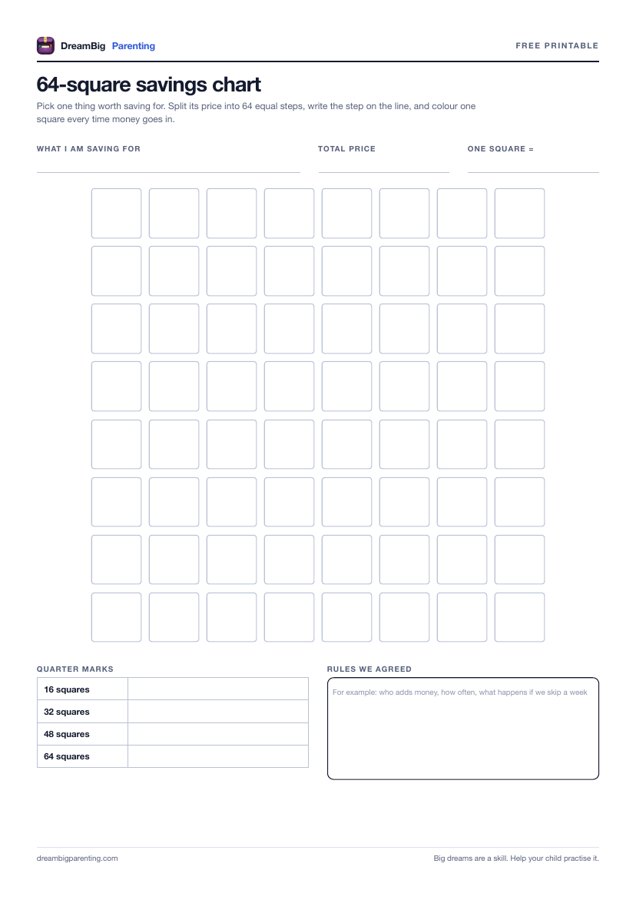
One goal, 64 equal squares, one colored per deposit.
Download the A4 PDF · all printablesWhat does not work, and why
Opening it and keeping the passbook. If your child never deposits or checks anything, it is your account with their name on it.
Treating joint and custodial as the same, or assuming 18 is the number. Ownership, withdrawals and tax differ, and the US custodial transfer age is state-set; a UK Junior ISA has 16 and 18 built in. Find out yours before your child does.
Comparing "when" before fees. A monthly fee on a $60 balance is saving in reverse. And when waiting gets hard, resist buying the thing yourself; the marshmallow test shows what waiting does and does not predict.
Key takeaways
- Opening: almost any age with a parent on it; no official minimum.
- Useful age: when your child has a goal and touches the money. Until then, a jar.
- Joint: you co-own it. Custodial: legally your child's until a state-set age.
- Check fees, withdrawal limits and the transfer age before comparing banks.
Frequently asked questions
Is there a legal minimum age to open a savings account for a child?
Not in the CFPB, FDIC or IRS guidance we reviewed. It is bank policy; a joint account with an adult can typically open from birth.
What age should a child have a savings account they actually use?
When they have a specific goal and make their own deposits, often the preteen years. A teen can start this month.
Is my child's savings account insured if the bank fails?
A US custodial account is FDIC-insured up to $250,000, separate from the custodian's own accounts; for a joint account, ask the bank.
When does the money become fully my child's?
A US custodial account transfers at an age set by the state, not automatically 18. A UK Junior ISA: control at 16, withdrawals from 18.
This article is general information, not financial or tax advice. Rules differ by state, country and bank; for your situation, talk to a licensed professional.
Sources
- Consumer Financial Protection Bureau (n.d.). Money as You Grow: Help for parents and caregivers. CFPB.
- Consumer Financial Protection Bureau (n.d.). Money milestones for young children. Money as You Grow, CFPB.
- Consumer Financial Protection Bureau (2016). Building Blocks to Help Youth Achieve Financial Capability: A new model and recommendations. CFPB research report.
- Cornell Law School Legal Information Institute (n.d.). Uniform Transfers to Minors Act. Wex, Cornell Law School LII.
- Federal Deposit Insurance Corporation (2024). Your Insured Deposits. FDIC brochure.
- Internal Revenue Service (n.d.). Topic no. 553, Tax on a child's investment and other unearned income (kiddie tax). IRS.
- HM Revenue & Customs (n.d.). SAIM2430 - Interest: taxation of interest: children's accounts. Savings and Investment Manual, HMRC internal manual, GOV.UK.
- GOV.UK (n.d.). Junior Individual Savings Accounts (ISA): Overview. GOV.UK.

Ilya Makarov is the founder of DreamBig, a visual savings-goal app for kids and teens. DreamBig Parenting articles separate what research shows from our interpretation and from practical experiments, and link every source. This article is general information, not medical, psychological or financial advice for a specific child.