Short answer
Passive screen time is consuming: watching videos, scrolling pictures, playing a game someone else made. Active screen time is creating: drawing your own picture, building your own level, filming your own video. Don't start by counting minutes. Ask one question: is my kid a consumer or a creator right now? Then help them take one step from the thing they already love to making their own version of it.

The first four rows are from my own house. I have a son who is 11 and a daughter who is 13, and this is how the idea works for us. The idea came out of a conversation in the car, driving the kids home after one of their practices. It boiled down to one question, and I still use it.
What passive vs active screen time means
When you play a game, watch TikTok, watch a video or scroll through pictures, you are a consumer. You use something someone else made. Building a LEGO set by the booklet is consuming too, even though it happens on the floor and not on a screen.
The ideal is to move from consumer to creator. You try to draw your own picture. You try to make your own game. You film your own video. My kids watch screencasts about Minecraft, so the creator version is to record a screencast of their own. Or you print a cube, or a small part, on a 3D printer.
Here is the part that matters most to me: consumer or creator is not a judgment. It is a way to orient yourself. Watching is fine. Kids need to watch good things to want to make things. The change I ask for is not "stop watching". It is a different angle: "why does this work?" instead of "do I like it?"
What the research says
Kids create very little on their screens. In the 2019 Common Sense census of US 8- to 18-year-olds, just 2% of tweens' screen use and 3% of teens' went to creating content such as writing, digital art or music. That was about 7 minutes a day for tweens and 12 for teens, "virtually unchanged since 2015" (Common Sense Media, 2019).
The American Academy of Pediatrics now points the same way. Its 2026 policy asks families to "move beyond simple screen-time limits and focus on quality, context and conversation" (Munzer, HealthyChildren.org). The AAP does not split screens into consuming and creating. That split is mine.
From consumer to creator, starting with what they love
The trick is not to invent a new hobby for your child. Take the thing they already consume for hours, and find the creator version of that exact thing.
My son loves LEGO and Minecraft. For him, creating meant programming mods for Minecraft and printing LEGO parts on our 3D printer. The printer runs under my supervision, but the part is his idea.
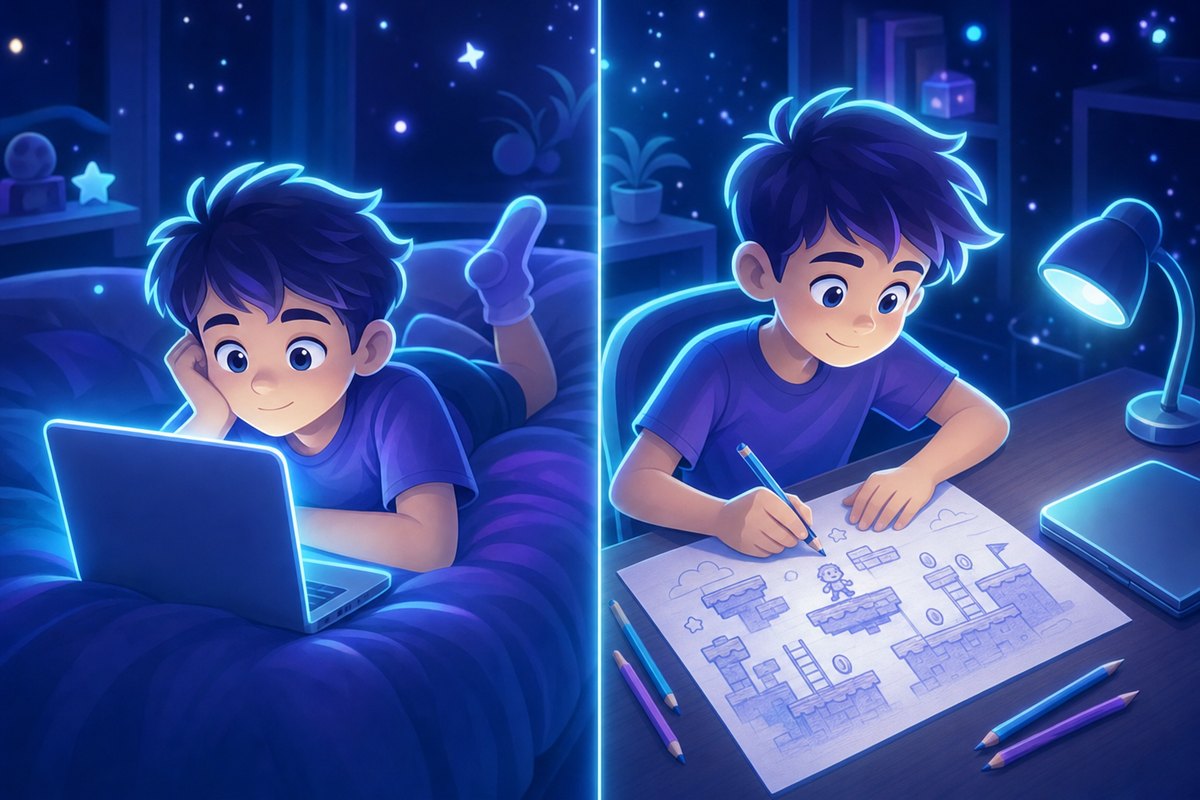
ConsumerWatching someone else play
CreatorDrawing a level of his own
My daughter loves Pinterest, screencasts, Toca Boca, series and anime. Her creator versions are drawing on a tablet, drawing comics, inventing her own anime characters, and making her own screencasts and Toca Boca stories. We bought her the tablet so she could learn to draw.
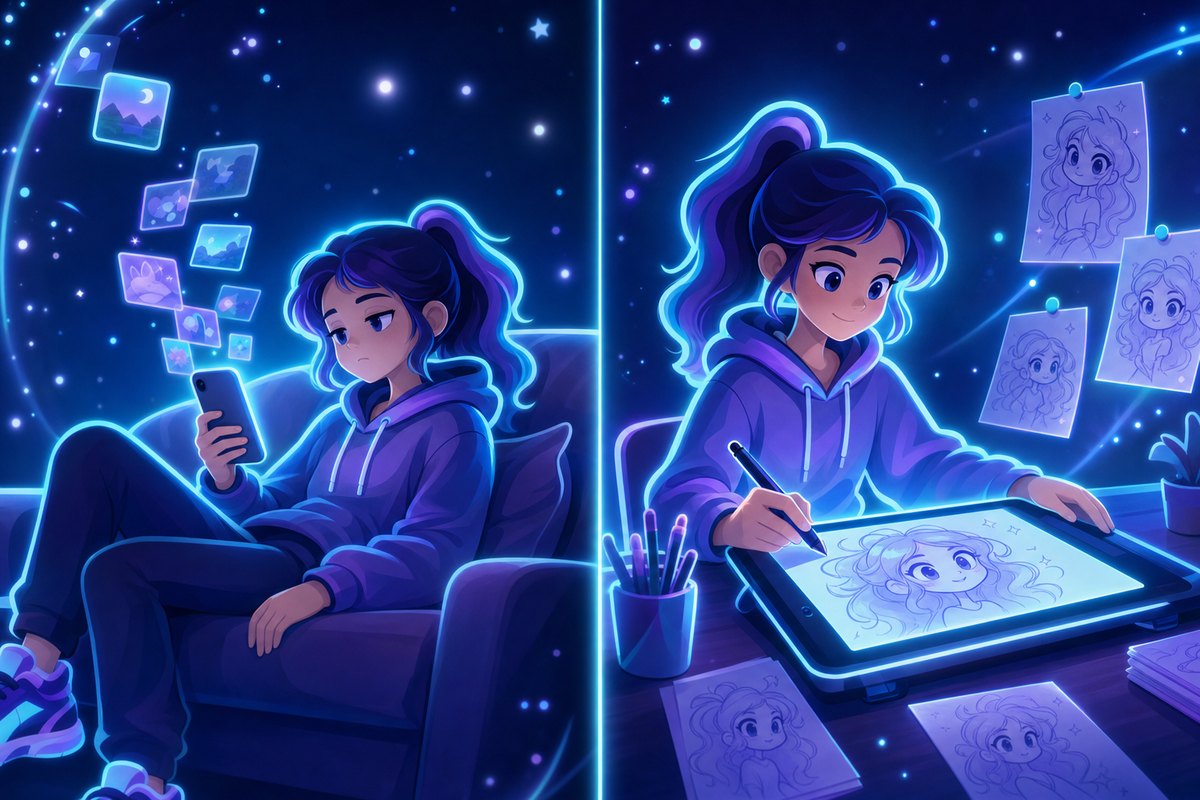
ConsumerScrolling other people's art
CreatorDrawing her own character
Notice that the creator version is often still a screen. A tablet, a laptop, a game engine. That is the point. The device is the same; what your child does with it is different.
How to talk about it without lecturing
The fastest way to kill this idea is to turn it into a rule or a speech. What works better is a question asked out of real curiosity, while your kid is watching or playing:
- "How was this made?" For a video, a game level, a drawing.
- "Why does this work?" Why is this video funny, why is this level hard, why do you like this character?
- "What would you change?" This one turns a viewer into a designer in one sentence.
- "Are you a consumer or a creator right now?" Ask it lightly, like a weather check, never as a verdict.
Our read
The question works because it is about a direction, not a score. A child who watched Minecraft screencasts all afternoon is not "bad". They now know a lot about what makes a good screencast. That knowledge is the raw material for making one. If you want the motivation side of this, our piece on raising a motivated child without pressure goes deeper.
What doesn't work: grading what they make, comparing it with what they watched, or making creating a chore they owe you before they are allowed to watch. A creation that has to pass inspection stops being theirs.
Lead by example: the day I made a game
If your child only consumes, start with yourself. Sit down, make something, and say: "Look what I made." In my experience this is the best way in.
One Saturday in May 2024 I was home alone for the weekend. I spent the whole day on a Godot tutorial, a free game engine. The tutorial video was 77 minutes long; going through it took me seven or eight hours. By the evening I had a small game: a level, coins, enemies, a character who could die.
I showed it to the kids. The next day they sat down and drew their own levels. Nobody asked them to. Later, with me next to them, they made a game in Godot.
That is not a one-off for me. My kids constantly see me building something, repairing something, experimenting. I think that matters more than anything I say about screens. If you want a structure for a bigger project, breaking a big goal into small steps works for a game or a comic the same way it works for anything else.
Does creator time count as screen time?
In our house, time spent creating does not count against the screen-time limit. It is a different thing. Our limit is about watching and scrolling.
To be clear, this is my position as a father, not science. The research above only says kids spend very little time creating, not that creating time is harmless in any amount. Sleep, school and moving still come first. Families who want to turn creator time into a daily routine can find a simple weekly plan in this guide to healthy screen time habits built around creator time. And when your kid does consume, it helps to choose well: here are educational YouTube channels for kids that are worth watching.
First steps by age
| Age | If they love… | Try making… |
|---|---|---|
| 8–10 | a game or a cartoon | a level or a character drawn on paper; a three-panel comic |
| 11–13 | Minecraft, LEGO, anime, Toca Boca | a short screencast, a mod, a 3D-printed part, a character on a tablet |
| 14–17 | shorts, series, music, games | one short video, a story or fan comic, a tiny game in a free engine |
Try this at home · 7 days
- Days 1–2: just notice. What does your kid consume most? Write down one thing.
- Day 3: ask one question while they watch: "How was this made?" Listen, don't teach.
- Days 4–5: make something yourself in front of them, in their world if you can: a drawing, a level, a short video. Then say "Look what I made."
- Days 6–7: offer the creator version of their favorite thing, with the tools ready. If they say no, that's fine. Try again next week.
Key takeaways
- Passive screen time is consuming; active screen time is creating. Ask "consumer or creator right now?" before you count minutes.
- It is an orientation, not a judgment. Watching is the fuel for making.
- Start from what your child already loves and find the creator version of that exact thing.
- Ask "how was this made?" and "what would you change?" instead of lecturing.
- Lead by example: make something yourself and say "Look what I made."
Frequently asked questions
What is passive screen time?
Passive screen time is time spent consuming what someone else made: watching videos or TV, scrolling feeds and pictures, playing a ready-made game. Active screen time is creating: drawing, building a level, coding, filming your own video. The same device can be used both ways.
What are examples of active vs passive screen time?
Watching Minecraft screencasts is passive; recording your own is active. Scrolling anime art is passive; drawing your own character on a tablet is active. Playing a game is passive; designing a level or a simple game in a free engine like Godot is active.
Does creating count as screen time?
The AAP doesn't split screen time this way. In our house, time spent creating does not count against the limit. That is my rule as a father, not a scientific finding, and sleep, school and moving still come first.
What if my child only wants to watch?
Don't ban the watching; it is the raw material. Ask how the thing was made, then make something yourself and show it. Leading by example works better than any rule I have tried.
At what age can a child move from consumer to creator?
At any age, with the right size of step. At 8–10 it can be a level drawn on paper; at 11–13 a screencast or a 3D-printed part; teens can make a short video or a tiny game.
Sources
- Rideout V, Robb MB (2019). The Common Sense Census: Media Use by Tweens and Teens, 2019. Common Sense Media.
- Munzer T. Helping Kids Thrive in a Digital World: AAP Policy Explained. HealthyChildren.org (American Academy of Pediatrics), 2026.
- American Academy of Pediatrics (2026). Digital Ecosystems, Children, and Adolescents: Policy Statement. Pediatrics.

Ilya Makarov is the founder of DreamBig, a visual savings-goal app for kids and teens. DreamBig Parenting articles separate what research shows from our interpretation and from practical experiments, and link every source. This article is general information, not medical, psychological or financial advice for a specific child.