
Short answer
The best delayed gratification activities for kids teach strategies, not stamina. Start by hiding the temptation: preschoolers waited about 9 minutes when the treats were taken away versus about 3 with them in view (Mischel and Ebbesen, 1970). Then describe it in dull words, keep hands busy, borrow a hero, agree an if-then line in advance, and keep your own small promises.

Your child wants the thing now: the checkout candy, the game a friend just got. You would like them to wait, without turning the kitchen into a lab.
The famous study is covered in our piece on what the marshmallow test really says. The short version: a preschooler's wait predicts little about their future once family background is counted (Watts, Duncan and Quan, 2018). This page is about practice: what to try, at what age, and what to say.
Waiting is a set of moves, not a stare-down
Children who wait well are rarely gritting their teeth. They are doing something with their attention, and a move can be learned.
What the research says
- Out of sight works. Preschoolers waited about 3 minutes with the treats in view and about 9 with no treats present (Mischel and Ebbesen, 1970, summarized by Simply Psychology).
- Successful waiters improvised. Some turned their backs or covered their eyes. Others made up songs or whispered the rules to themselves (Bing Nursery School, Stanford; observation, not a controlled test).
- Busy hands help because they distract. Waits grew when children had work to do, and the gain came from the distraction. "Fixing attention on rewards was a particularly detrimental strategy regardless of the type of task" (Peake, Hebl and Mischel, 2002).
- Cool words beat hot ones. Metcalfe and Mischel describe a hot, emotional "go" system and a cool, thinking "know" system, and the cool one develops later. Preschoolers told to "put a frame around" the treats in their head waited almost 18 minutes (Metcalfe and Mischel, 1999, a theory paper reporting earlier studies).
- Trust changes the math. In a study of 28 preschoolers, those who saw an adult keep two small promises waited about 12 minutes on average. Those who saw the promises broken waited about 3. Nine of 14 waited the full 15 minutes, versus 1 of 14 (Kidd, Palmeri and Aslin, 2013).
Our read
Almost all of this comes from 3- to 6-year-olds in short lab sessions. What carries over to older kids, we think, is the mechanism. Move attention away from the prize, make it less vivid, and give the child reason to trust the wait.
Delayed gratification activities for kids, by age: games and habits
Nine activities, each tied to the strategy it trains. Eight practice waiting; one (stop-and-go games) warms up stopping on cue for younger kids. "Our adaptation" means no one has tested it at that age.
| Activity (what it trains) | Ages | Time | What to say |
|---|---|---|---|
| 1. Out of sight: a box, a drawer, another room removing the cue | 4–10 | 1 minute | "Let's give it a hiding place until Saturday." |
| 2. Frame it, or make it boring cooling the prize | 4–7 frame; 8–13 dull catalog (our adaptation) | 1–2 minutes | "Put a frame around it in your head." / "Describe it like a boring catalog." |
| 3. Busy hands during short waits switching attention | 4–10 | The wait itself | "While we wait, can you sort the spoons?" |
| 4. Hero mode stepping outside yourself | 4–7; 8–10 as play (our adaptation) | 5–10 minutes | "What would your hero do while waiting? Be them now." |
| 5. If-then line, said aloud three times planning ahead | 8–13 | 2 minutes, before the moment | "Whenever I see ___, then I will ___." |
| 6. Promise ledger: you write small promises, they tick them trust that waiting pays | All ages | 30 seconds per promise | "I said Friday. It's Friday. Tick." |
| 7. Level up once it's easy steady, rising challenge | 4–13 | 5 minutes, a few times a week | "Last time was 3 days. Want to try 5?" |
| 8. Stop-and-go games: Red Light Green Light, Freeze Dance, Simon Says stopping on cue (our suggestion) | 4–8 | 5 minutes | "Freeze when the music stops." |
| 9. One real long wait the child chooses using the skill where it matters | 5–17 (under 8: a short goal, 1–2 weeks) | 10-minute setup, then weeks | "You choose the goal. I'll keep my side." |
Activities 1–3 are explained above under "What the research says"; the rest follow. Stop-and-go games are our practical suggestion: they train stopping on cue, not waiting.
Hero mode (ages 4 to 7)
In a study of 180 children aged 4 and 6, those who pretended to be a character like Batman spent 46% of a boring 10-minute task working. Children using third-person self-talk worked 36% of the time, and first-person 29% (White and colleagues, 2017). That measured sticking with a task, not waiting for a reward. Preschoolers in a Superman cape also waited longer (Karniol and colleagues, 2011).
The if-then line (ages 8 to 13)
This is the activity with the best evidence for older kids. In a German study, 10- and 11-year-olds made 40 choices between 1 point now and 3 points after a 30 to 60 second wait, with points paid as money. Children who said "Whenever a red picture appears, then I will wait for the blue one" three times aloud waited better than children who only got the instructions. It helped children with and without ADHD (Gawrilow, Gollwitzer and Oettingen, 2011). The waits lasted seconds, so treat it as promising, not proven. At home, set the line before the trigger: "Whenever a friend shows me a new game, then I'll add it to my wish list and decide on Sunday."
The promise ledger (all ages)
This one is for you. Write down small promises ("park on Friday") and let your child tick them when you keep them. The size of the trust effect varies across studies. In 149 Japanese children aged 4 to 6, an untrustworthy adult did not significantly change wait times, though children said waiting "took more work" (Yanaoka and colleagues, 2026). Our practical suggestion: let them see you wait, too, and say so out loud.
Level up (ages 4 to 13)
A review of programs for children aged 4 to 12 found that skills like self-control improve only when the practice keeps getting harder. "Even the best activity for improving EFs if done rarely produces little benefit" (Diamond and Lee, 2011). So stretch the wait once it feels easy, and repeat often.
Try this at home · 7 days
- Day 1. Pick one activity from the table that fits your child's age. Ask if they want to try it. A no is fine.
- Days 2–3. Use it once a day on something small: dessert after dinner, a show after homework.
- Day 4. Add one kept promise to the ledger and say it out loud when you deliver.
- Days 5–6. Stretch the wait slightly, only if your child agrees.
- Day 7. Ask what helped. Compare only with their own Day 2, never with a sibling. If it went well, pick one real thing to wait for (next section).
Pick one real long wait
One catch: the same review found that "benefits usually don't generalize to unpracticed EF skills" (Diamond and Lee, 2011). A child who masters a waiting game may still grab at the checkout. So move the practice to a wait that matters to them.
Saving is the cleanest version. Say your 9-year-old wants a $32 building set. On a 64-square chart, every 50 cents saved colors one square, so one long wait becomes many small, visible steps. For a 5- to 7-year-old, shrink it: a $5 toy, 10 squares, one colored for each coin. The chart works the same, just shorter. Checkpoints like these are our practical suggestion; we found no study testing them in children. For the money side, see how to teach kids to save money with one goal. To turn the goal into steps, use our guide to goal setting for kids.
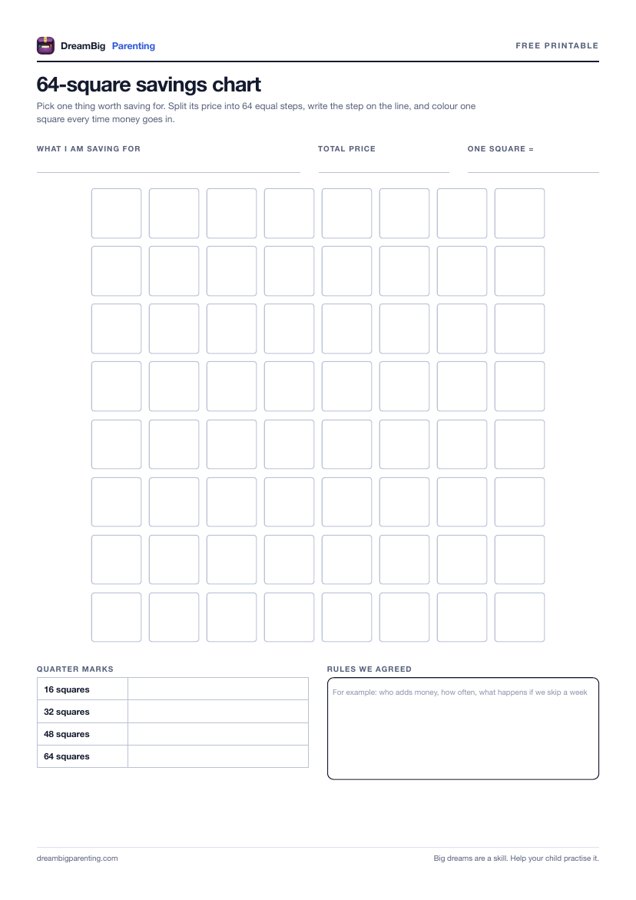
One goal your child chose, 64 equal squares, one colored in for each deposit.
Download the free PDF (A4; on US Letter, choose “Fit to page”). All printablesTeens 14 to 17: where the evidence runs out
No study has tested these activities with 14- to 17-year-olds, so this is our practical suggestion. Skip the preschool tricks. Let the teen choose the goal and the strategy, and offer the if-then line as something they write in their phone notes.
Also accept that spending can be the right call. In a small study of 16 girls aged 4 to 12, all the 12-year-olds shifted toward the small, quick reward as the delay grew. The authors read this as children learning "when it is in fact profitable to wait" (Sonuga-Barke, Lea and Webley, 1989). A teen who decides a goal is not worth six more weeks may be reasoning well.
What does not work
- Turning practice into a verdict. "See, you can't wait" teaches nothing, and one wait predicts little. Clinical psychologist Matthew Rouse advises starting with a game "in which they're not overly invested" (Child Mind Institute).
- Breaking small promises. In the Kidd study, children who saw promises broken stopped waiting much sooner.
- The same easy game forever. Without rising challenge, the review found no gains.
- Group pressure as shaming. In one of two lab experiments, preschoolers told their group waits held out longer: a median of about 15 minutes versus 6 (Doebel and Munakata, 2018). No one was singled out. "In our family we save for the big thing" is fine. "Your sister can wait" is not.
- Piling on prizes. Our read: if every wait earns a sticker, the sticker becomes the point (see do reward charts work).
For the moment a wait ends in a no, our guide on how to teach kids to handle disappointment picks up from here.
When to get help: if your child's impulsivity shows up at home and at school, puts them in danger (darting into traffic, grabbing from strangers), or hasn't eased after a few months of steady practice, talk to your pediatrician. A clinician can check for ADHD or other causes and suggest a plan.
Key takeaways
- Waiting is a set of strategies: hide it, cool it, keep busy, plan it, trust it.
- Keep your own small promises: in one study, kids who saw promises kept waited about four times longer.
- Keep the stakes low, raise the challenge slowly, and practice often.
- Skills transfer narrowly, so move to one real wait your child chooses.
- With teens, let them choose the goal and the strategy, and respect a reasoned no.
Frequently asked questions
What are good delayed gratification activities for kids?
Hide the temptation, cool it with dull words, keep hands busy, play hero mode, set an if-then line, and keep a promise ledger. Most were tested with preschoolers, the if-then line with 10- and 11-year-olds.
Can delayed gratification be taught?
Waiting shifts a lot with the situation: a hidden treat, cooler thoughts, a trusted adult. If-then plans helped 10- and 11-year-olds in a lab task. No study shows that home games change long-term outcomes, and practice transfers narrowly.
Does the marshmallow test predict success?
Only weakly, once family background is counted. Our marshmallow test explainer covers what the original study and its replications found.
What age should we start?
Start as soon as your child can play a simple game, around 4. The cool, thinking system matures later than the hot one, so move from concrete tricks to plans and real goals as your child grows.
How do I teach a teenager to wait?
Use a real goal they chose and an if-then plan they write themselves. Respect their reasoning: older children learn when waiting is not worth it.
Sources
- Kidd, Palmeri & Aslin (2013). Rational snacking: Young children's decision-making on the marshmallow task is moderated by beliefs about environmental reliability. Cognition.
- Watts, Duncan & Quan (2018). Revisiting the Marshmallow Test: A Conceptual Replication Investigating Links Between Early Delay of Gratification and Later Outcomes. Psychological Science.
- Metcalfe & Mischel (1999). A Hot/Cool-System Analysis of Delay of Gratification: Dynamics of Willpower. Psychological Review.
- Peake, Hebl & Mischel (2002). Strategic Attention Deployment for Delay of Gratification in Working and Waiting Situations. Developmental Psychology.
- Gawrilow, Gollwitzer & Oettingen (2011). If-Then Plans Benefit Delay of Gratification Performance in Children With and Without ADHD. Cognitive Therapy and Research.
- Doebel & Munakata (2018). Group Influences on Engaging Self-Control: Children Delay Gratification and Value It More When Their In-Group Delays and Their Out-Group Doesn't. Psychological Science.
- Diamond & Lee (2011). Interventions shown to Aid Executive Function Development in Children 4–12 Years Old. Science.
- Yanaoka, Michaelson, Saito & Munakata (2026). Waiting Longer With Less Work: The Impact of Habits and Social Trust on Children's Delay of Gratification. Developmental Science.
- Sonuga-Barke, Lea & Webley (1989). The development of adaptive choice in a self-control paradigm. Journal of the Experimental Analysis of Behavior.

Ilya Makarov is the founder of DreamBig, a visual savings-goal app for kids and teens. DreamBig Parenting articles separate what research shows from our interpretation and from practical experiments, and link every source. This article is general information, not medical, psychological or financial advice for a specific child.