

Short answer
If you are thinking "my child wants an expensive gift, what do I say," skip the flat no and the instant yes. Try "yes, if": you pay what the basic version costs, and your child saves toward the rest with a small, capped match. What they help fund, they are likely to value more.
The ask lands in the car, at bedtime, or a month before a birthday with the price already looked up.
Why "my child wants an expensive gift" is often not about the gift
Ask what the thing is for before you talk price.
What the research says
Materialism in 8- to 18-year-olds follows an inverted U: it rises from ages 8 to 9, peaks at 12 to 13 and falls by 16 to 18 (Chaplin & John, 2007). The driver was self-esteem, not age alone. In a second, experimental study, raising teens' self-esteem erased the age differences; the first study was correlational.
So "everyone at school has one" is often about self-esteem and belonging more than the object. Name that first: "Sounds like it matters to be in on this." Then talk money.
The script: three replies that turn a wish into a plan
Each hands your child part of the decision.
1. Wait and save part of it
"Yes to the goal. Set a date; you save the first part, and I match it up to $X." Of 54 U.S. children's savings programs in a CFPB survey, 70 percent used a seed deposit, commonly $50, and 52 percent matched savings, typically dollar for dollar up to a yearly cap (CFPB, 2019). Programs, not families.
2. Pay the difference
Ron Lieber, author of The Opposite of Spoiled, calls this the "Lands' End line." You name the price you would pay for the need version, in his example $40 for boots. A $60 or $100 pair means the child pays the gap (Lieber, 2015). "I cover the basic one. Anything above is yours." Advice, not a study.
3. A named alternative
Sometimes it is off the table. Say so, with something real attached: "Not the console this year, but I can do the game, or $60 toward your next goal."
| Reply | What you say | What your child learns |
|---|---|---|
| Wait and save part of it | "Set a date. You save first; I match up to $X." | A want becomes a plan with a date |
| Pay the difference | "I pay for the basic one. The upgrade is on you." | Upgrades cost extra; they judge the worth |
| A named alternative | "Not this one. Here is what I can do." | A no can still come with a choice |
Adjust by age
At 8 to 10, keep it to weeks and cover most of it. In one small study, planning around a time horizon was adult-like by 11 to 12 but not at 5 to 6 (Zhuang, Niebaum & Munakata, 2023). At 11 to 13, around the wanting peak, a multi-week goal with a chart and a capped match fits. At 14 to 17, your teen researches prices, earns part of the gap and judges the upgrade.
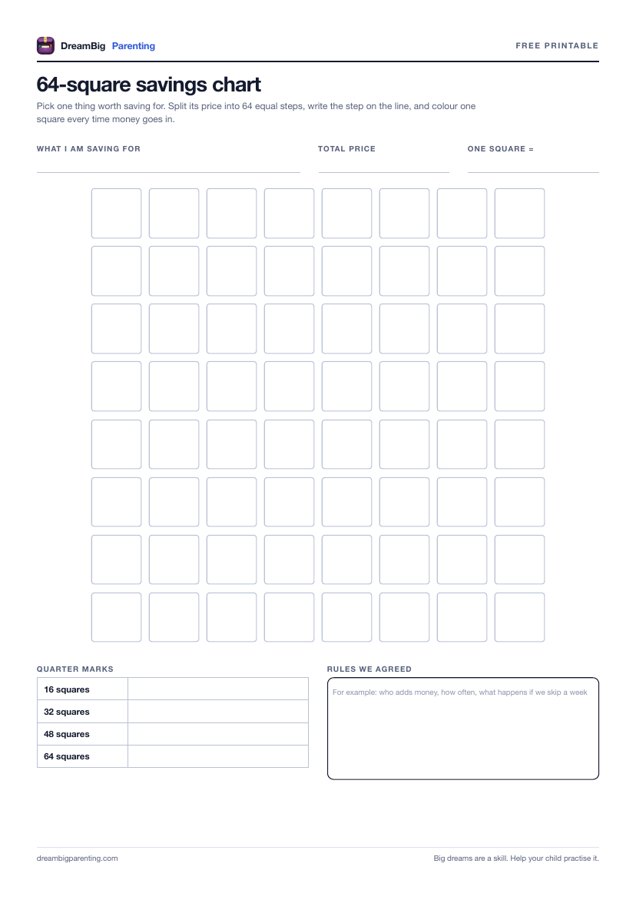
Split the gap into 64 squares; your child colors one per deposit.
Download the A4 PDF · all printablesWhy a shared contribution beats a gift outright
Money is the obvious argument. The better one is ownership.
What the research says
Adults who built a box or folded origami valued the result more for having made it. The effect vanished when the build was left unfinished or taken apart (Norton, Mochon & Ariely, 2012). Effort also held up better when a goal looked like a bar filling up rather than a stopwatch counting down (Cheema & Bagchi, 2011). Both are adult studies; applying them to kids is an extrapolation.
Our read
Your child funds a real share. Progress is visible, on a chart or in a jar. The match is small and capped. Nobody rescues the goal halfway; unfinished builds earned nothing extra. That filling picture is the idea behind DreamBig, our app coming soon to iPhone and Android. A paper chart does the same job, since visible progress, not the reward, is the part that works.
Try this at home · 7 days
A one-week trial of reply one, run like any goal broken into steps. Your child can decline.
- Day 1: They look up the price. You name your baseline and the match cap.
- Day 2: Split the gap into squares on a chart, and pick a jar or an account in their name.
- Days 3 to 6: Each deposit, they color a square and you add the match. No reminders.
- Day 7: Look at the chart together. Still want it? Either answer is fine.
What does not work, and why
Paying all of it, or buying it early to end the asking. A finished gift skips the effort that, in the adult studies, raised its value; an interrupted build lost that effect.
A number instead of a picture. A bar that fills kept adults going; a countdown did not. For sizing, see one savings goal.
An uncapped match. In adult research the CFPB cites, offering a match mattered more than its size, and a higher match rate may shrink the total a person saves (CFPB, 2019).
Treating it as a character test. The marshmallow link with later achievement shrank by two thirds once family background was controlled (Watts, Duncan & Quan, 2018); read what the marshmallow test really says first.
Key takeaways
- Neither no nor yes: "yes, if," with a number attached.
- Three replies: wait and save part, pay the difference, a named alternative.
- In adult research, a match raised the rate of saving; keep it dollar for dollar and capped.
- Visible progress beats a countdown; do not rescue the goal halfway.
Frequently asked questions
What should I say when my child asks for something expensive?
Three options, not yes or no: wait and save toward part of it, pay the difference above a baseline price, or a named alternative.
Why should my child pay part of the cost?
In adult studies, a finished creation was valued more when self-made, and offering a match raised the rate of saving more than the match's size did.
My child wants an expensive gift because "everyone has it." What do I say?
That want peaks at 12 to 13 and tracks self-esteem more than the object. Name the feeling, then offer the three replies.
How do I keep my child interested until the goal is reached?
Something that visibly fills up: a chart, jar or picture in squares. In adults, a filling image sustained effort; a countdown did not.
This article is general information, not financial advice. Rules differ by state and bank; for your situation, talk to a licensed professional.
Sources
- Chaplin, L.N. & John, D.R. (2007). Growing up in a Material World: Age Differences in Materialism in Children and Adolescents. Journal of Consumer Research, 34(4), 480–493.
- Norton, M.I., Mochon, D. & Ariely, D. (2012). The IKEA Effect: When Labor Leads to Love. Journal of Consumer Psychology, 22(3), 453–460.
- Cheema, A. & Bagchi, R. (2011). The Effect of Goal Visualization on Goal Pursuit: Implications for Consumers and Managers. Journal of Marketing, 75(2), 109–123. Summarized in Easy to visualize goal is powerful motivator to finish a race or a task, ScienceDaily (Virginia Tech), August 17, 2011.
- Watts, T.W., Duncan, G.J. & Quan, H. (2018). Revisiting the Marshmallow Test: A Conceptual Replication Investigating Links Between Early Delay of Gratification and Later Outcomes. Psychological Science, 29(7), 1159–1177.
- Zhuang, W., Niebaum, J. & Munakata, Y. (2023). Changes in Adaptation to Time Horizons across Development. Developmental Psychology, 59(8), 1532–1542.
- Consumer Financial Protection Bureau (May 2019). Child Savings Accounts: Using incentives to encourage participation. CFPB.
- Legg, H. (2015). Ron Lieber #51, interview with the author of The Opposite of Spoiled. The Editorial, February 11, 2015.

Ilya Makarov is the founder of DreamBig, a visual savings-goal app for kids and teens. DreamBig Parenting articles separate what research shows from our interpretation and from practical experiments, and link every source. This article is general information, not medical, psychological or financial advice for a specific child.